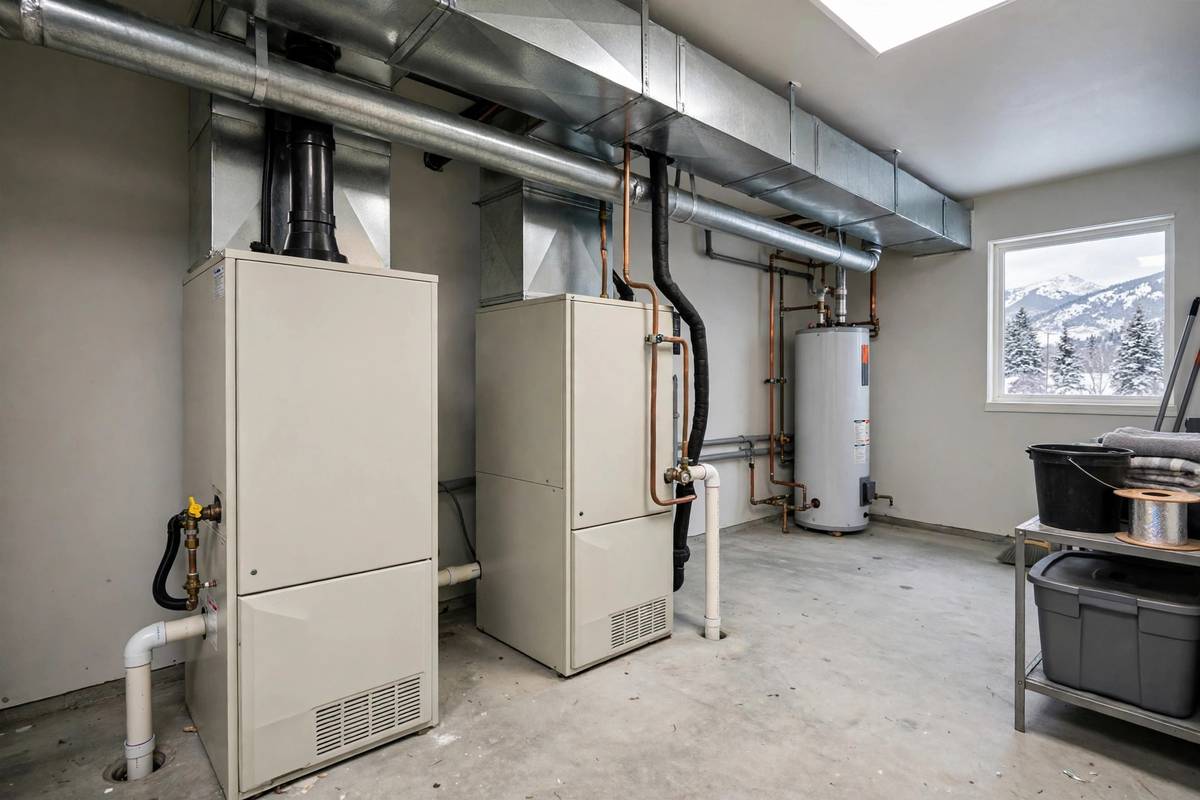
New furnaces sized for altitude, installed to code
Furnace Installation in Fort Collins, CO
A new furnace in Fort Collins is a heating-season decision, and the heating season is most of the year: 5,797 heating degree days against 624 cooling degree days, a 99.6% design temperature of around 0°F (ASHRAE 99.6% value 0.1°F), and about 150 freezing nights a year. The install that matters is the one sized for 5,003 feet of altitude, built around Colorado’s ultra-low-NOx rule, and permitted and inspected by the City of Fort Collins. DNA Refrigeration installs gas furnaces across Fort Collins. Call (970) 932-2324.
Sized for altitude, vented and commissioned to code.
About this service
How a New Furnace Is Sized and Installed at 5,003 Feet
Furnace installation is not a swap. It is a load calculation, an equipment selection, a venting and gas design, a mechanical permit, and a startup and commissioning sequence — in that order. A furnace that is the wrong size, vented wrong, or never commissioned will heat badly for its whole life, whatever the efficiency number on the box says.
Sizing is where Fort Collins altitude bites. At 5,003 feet the City’s mechanical guide puts furnace derating at 10–20%, and sea-level AHRI ratings do not apply here. A proper install starts with an ACCA Manual J load calculation against the local design temperature — around 0°F at the 99.6% level (ASHRAE 99.6% value 0.1°F) — and selects equipment against its derated output, not its sea-level label. Oversizing is just as costly as undersizing: a furnace that short cycles wears out faster and leaves rooms uneven.
Two 2026 rules shape every install. Colorado’s HB23-1161, in force 1 January 2026, requires furnaces at or below 14 ng/J of NOx — the ultra-low-NOx standard — and the 2024 I-Codes took effect in Fort Collins on 1 April 2026. A furnace replacement triggers a mechanical permit, applied for through the City’s Accela Citizen Portal, valid for 180 days, with rough-mechanical and final inspections. Permit fees were not verified at the time of writing, so no fee figure is published here.
Altitude shapes the diagnosis too. Fort Collins sits at 5,003 feet, and the City’s mechanical guide puts furnace derating at 10–20% at this elevation — sea-level ratings do not apply here. A furnace that was sized from a sea-level table runs long cycles and still leaves rooms cold, which looks like a repair problem but is really a sizing problem. Good repair work in this city starts with the temperature rise across the heat exchanger and the data plate, not with a guess.
✓ ACCA Manual J load calculation at altitude
✓ Ultra-low-NOx equipment (HB23-1161, from 1 Jan 2026)
Six things decide whether a new furnace heats well for twenty years or fights the house from day one. Every installation we do covers all six.
01
✓
Load Calculation First
An ACCA Manual J calculation against Fort Collins design conditions — around 0°F winter design (ASHRAE 99.6% value 0.1°F), 5,797 heating degree days — and the derated output at 5,003 feet. The furnace is selected to the calculation, not to the size of the furnace coming out.
02
✓
The Right Efficiency for the House
There is no minimum AFUE requirement in Colorado — the claim that furnaces must be 95% efficient is false. The choice is between an 80% furnace and a 90%+ condensing furnace, and it turns on the house: venting routes, condensate drainage, gas prices, and how long you plan to stay. A condensing furnace needs a drain that will not freeze; an 80% unit needs a sound flue.
03
✓
Ultra-Low-NOx Equipment
Since 1 January 2026, Colorado’s HB23-1161 requires furnaces at or below 14 ng/J of NOx. Every furnace we install meets that standard. It is the 2026 rule that replaced the old efficiency conversation — and it is why 2025 price guides no longer describe the market.
04
✓
Venting and Combustion Air
Venting is designed for the equipment and the house: sealed combustion on condensing units, correct flue sizing on 80% units, and combustion air that actually reaches the furnace. Bad venting shows up as nuisance lockouts, condensation damage, and carbon monoxide risk.
05
✓
Gas Piping and Condensate
Gas lines are sized and pressure-tested, and on condensing furnaces the condensate drain is routed, trapped, and pitched so it drains — and, critically, so it does not freeze in an unheated space and shut the furnace down on the first hard cold snap.
06
✓
Commissioning and Testing
Startup is not flipping a switch. Gas pressure is checked against the data plate, temperature rise is measured, the flue is read with a combustion analyzer, and the system is run through full heat cycles before the permit’s final inspection is called.
How it works
What to Expect From Our Furnace Installation Process
We measure the house, check insulation and windows, look at the existing ductwork, and run the Manual J calculation. The age and condition of the existing furnace and the home’s heating history all feed the sizing decision.
You get the equipment options that fit the calculation — including the ultra-low-NOx requirement — the venting and condensate plan, and the full scope of work in writing before anything is ordered.
A mechanical permit is applied for through the City of Fort Collins Accela Citizen Portal. The permit is valid for 180 days and covers the rough-mechanical and final inspections.
The old furnace is removed, the new unit is set, venting and gas piping are run, the condensate drain is routed, and the thermostat is wired. The work area is left clean and the old equipment is removed.
Gas pressure, temperature rise and combustion readings are verified, the furnace is run through full heat cycles, and the City’s final mechanical inspection is scheduled. Only then is the job finished.
STEP 01Load Calculation and Assessment
We measure the house, check insulation and windows, look at the existing ductwork, and run the Manual J calculation. The age and condition of the existing furnace and the home’s heating history all feed the sizing decision.
Tools & methods
Tools and Methods We Use on Every Furnace Installation
01
✓
Manual J Load Software
ACCA Manual J calculations against Fort Collins design temperatures, with altitude derating applied — the basis for every sizing decision.
02
✓
Combustion Analyzer
Reads oxygen, carbon monoxide and flue temperature at startup, confirming the new furnace burns clean and safe.
03
✓
Digital Manometer
Verifies gas pressure and manifold pressure against the data plate at 5,003 feet, where altitude changes the numbers.
04
✓
Torque Wrench Set
Gas and flue connections tightened to specification, not by feel.
05
✓
Level and Plumb Tools
Condensate drains only work when they are pitched. The furnace and the drain are set true so water flows out, not back.
06
✓
Flue-Gas Thermometer
Confirms flue temperatures are in range for the equipment type — too cool on an 80% furnace means condensation in the flue; too hot wastes fuel.
Real results
Furnace Installations We See Across Fort Collins
Furnace Installation
Second Furnace in a 1992 Midtown Home
Homes built around 1992 — the city’s median build year — are hitting their second or third furnace. The original unit is long gone, the replacement is ageing, and the ductwork was designed for a different era of equipment.
After: A replacement here starts with a fresh load calculation rather than matching the old nameplate, because insulation, windows and the house itself have changed since the first install. The new furnace is sized to the house as it stands today, at altitude.
Newer Rigden Farm homes are built for condensing furnaces, which means a condensate drain that must work through a Fort Collins winter. The drain route matters as much as the furnace: a line through an unheated space is a freeze waiting to happen.
After: The install routes the condensate inside conditioned space wherever possible, traps and pitches it correctly, and verifies drainage at startup — so the first hard freeze does not become a no-heat call.
Old Town homes bring tight mechanical rooms, old flues, and buildings over 50 years old, where exterior alterations need Historic Preservation review. A furnace swap that changes the exterior — a new vent termination, for example — has to be planned around that.
After: The install is designed around the existing venting where it is sound, and any exterior change is sited for the lowest visual impact. Old Town guidelines treat exterior HVAC as a visibility issue, not a ban.
A furnace sized from a sea-level table runs constantly at 5,003 feet and still leaves rooms cold. Manual J with altitude derating applied is the fix — sizing to derated output, not the box label.
↗02
Short cycling from oversizing
A furnace far larger than the load fires, satisfies the thermostat in minutes, and shuts off — over and over. It wears out faster and heats unevenly. The load calculation is what prevents it.
↗03
Venting and condensate freeze
Condensing furnaces make water, and that water freezes in an unheated space. Correct routing, trapping and pitch — inside conditioned space where possible — keeps the drain working through January.
↗04
Old furnace, new AC mismatch
A new furnace paired with an ageing air conditioner can leave the blower and coil mismatched. The install plan looks at the whole system, not just the box being replaced.
↗
Proof you can check
How HVAC licensing works in Fort Collins
Colorado has no state HVAC licence — HVAC work in Fort Collins is licensed by the City of Fort Collins, not the state. Colorado licenses only electricians and plumbers at the state level. Fort Collins licenses HVAC contractors through the City — ask us for our licence details when you call. We pull a mechanical permit for replacements through the City’s Accela portal, and size equipment to ACCA Manual J. Refrigerant handling follows EPA Section 608 rules.
City of Fort Collins contractor licensing — HVAC is licensed locally, not by the State of Colorado
Mechanical permits for furnace, AC and heat-pump replacements, applied for through the Accela Citizen Portal
ACCA Manual J load calculations, sized for 5,003 feet of altitude
5.0 ★ (23 Google reviews) — every review on Google is five stars
Customer reviews
What Fort Collins Customers Say
★★★★★
“Fantastic business! Dennis is amazing, fixes, replaces, installs and knows everything about his profession. He under cut another competitor by $5800 and never exaggerates work that doesn't need doing. Very trustworthy, and very much appreciated. I have another whole AC unit that will need replacing soon, and I know who I'm going to for the job. Thanks!”
JH
James HadleyGoogle review · 5 months ago
✓ Verified
“
★★★★★
“Professional,reliable, honest, and friendly service. Owner operator was top level with his knowledge and skill. Dennis runs a solid business that I most definitely highly recommend.”
PA
Peter AmbroseGoogle review · 9 months ago
✓ Verified
At a glance
Problem
What we check or do
Furnace undersized at altitude
A furnace sized from a sea-level table runs constantly at 5,003 feet and still leaves rooms cold.
Short cycling from oversizing
A furnace far larger than the load fires, satisfies the thermostat in minutes, and shuts off — over and over.
Venting and condensate freeze
Condensing furnaces make water, and that water freezes in an unheated space.
Old furnace, new AC mismatch
A new furnace paired with an ageing air conditioner can leave the blower and coil mismatched.
Good questions
Furnace Installation Questions Fort Collins Homeowners Ask
Published ranges, checked November 2026: a modelled Fort Collins install of an 80k BTU, 95–96% AFUE furnace ran $5,270–$8,640 (NumeralQ, 26 October 2026, modelled — not a contractor bid). Fort Collins contractor-quoted installs ran $7,000–$10,000 in 2026 (Lion, Fort Collins, ultra-low-NOx models including permit, venting and commissioning). Nationally, Angi published $2,823–$6,897, averaging $4,814 — that is the national floor, not a Front Range price. Final cost depends on size, venting, gas work and condensate routing.
Yes. Furnace replacements trigger a mechanical permit in Fort Collins. Applications and inspection scheduling run through the City’s Accela Citizen Portal, permits are valid for 180 days, and the work is covered by rough-mechanical and final inspections. Permit fees were not verified at the time of writing.
Colorado House Bill 23-1161, in force 1 January 2026, requires furnaces sold and installed in Colorado to emit no more than 14 ng/J of nitrogen oxides — the ultra-low-NOx standard. It is a 2026 emissions rule, not an efficiency rule: there is no minimum AFUE for furnaces installed after 2019, despite claims still circulating online.
With an ACCA Manual J load calculation against the local design temperature (around 0°F at the 99.6% level; ASHRAE 99.6% value 0.1°F), then derating the equipment output for 5,003 feet of elevation. The City’s mechanical guide puts furnace derating at 10–20% at this altitude, and sea-level ratings are ignored. A furnace sized from a sea-level table is undersized here.
A furnace is a twenty-year decision in a city with 5,797 heating degree days. Call (970) 932-2324 and we will talk through the load calculation, the ultra-low-NOx equipment, the permit, and the full scope — before any work starts. We are open 24 hours, every day.
Call us at (970) 932-2324 any time, day or night. We are open 24 hours, 7 days a week. There is no email address for the business — the phone is the way to reach us.