Duct leakage test first
We measure leakage before any sealing starts, so the job is sized to the actual problem and the result can be proven afterwards. Sealing without a test is guessing.
Leaky ducts are the most expensive invisible problem in a Fort Collins home. Conditioned air escapes into the attic, the crawlspace and the wall cavities, and unconditioned air is drawn in to replace it — so the furnace and the air conditioner both run longer, the upstairs stays hot, the basement stays cold, and the dust in the attic ends up in the rooms. Duct how to seal leaky air ducts closes those leaks at the joints, seams and connections, and it is measured before and after so the improvement is a number, not a promise. DNA Refrigeration Heating & Cooling seals ductwork across Fort Collins. Call (970) 932-2324 any time.
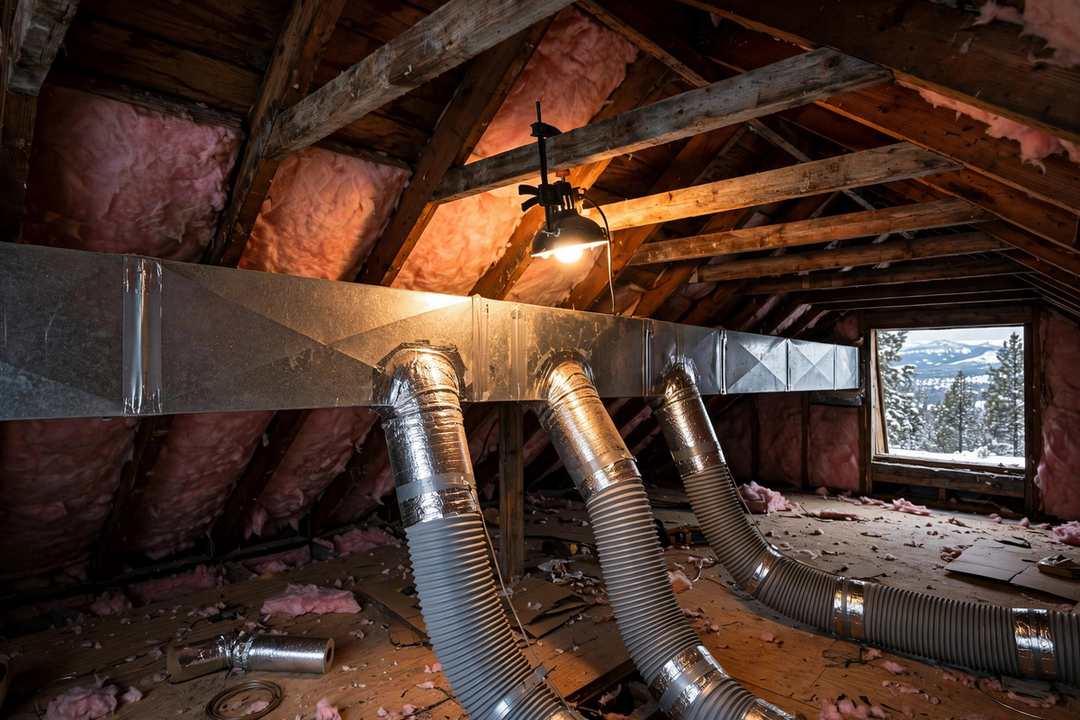
Duct sealing is the closing of leaks in the duct system — at joints, seams, take-offs and the connections to the air handler and the registers — with mastic, tape rated for the job, or an aerosol sealant applied from inside the ducts. The work is tested with a duct leakage test before and after, so the result is measured.
The Fort Collins case is driven by the age of the housing stock. Nearly half the city's homes are pre-1990, and their ductwork is often as old as the house: joints that were never sealed properly in the first place, tape that has dried and fallen off over thirty summers, and runs that were retrofitted into attics and crawlspaces where nobody has looked since. In a heating-dominant city — 5,797 heating degree days against 624 cooling — duct leakage wastes heat all winter and cool air all summer, and it also drives the comfort complaints that get blamed on the furnace or the air conditioner: the hot upstairs, the cold basement, the room that never quite reaches the set temperature. Sealing is also the step that makes a new high-efficiency system actually deliver its rated efficiency — a new unit on leaky ducts is a new engine in a car with holes in the fuel line. The dated cost figure, checked November 2026: duct sealing ran $375–$6,000, averaging about $2,250 (Angi). That is a national range covering everything from a few accessible joints to a full aerosol seal of a large system; your quote depends on the size of the system, the accessibility of the runs and the leakage measured.
A sealing job should leave the ducts measurably tighter, the rooms more even, and the system running less. Here is what goes into that.
We measure leakage before any sealing starts, so the job is sized to the actual problem and the result can be proven afterwards. Sealing without a test is guessing.
Joints, seams and take-offs that can be reached are sealed with mastic and tape rated for ductwork — not the cloth tape that dries out and falls off in a few summers.
Where runs are buried in walls or inaccessible, an aerosol sealant applied from inside the ducts seals leaks from within. We explain where hand sealing ends and aerosol begins, and why.
The largest leaks are often at the connections: where the ducts meet the air handler, and where the runs meet the registers. Both are sealed and checked as part of the job.
Sealing is usually sold on energy, but the result homeowners notice first is comfort: the upstairs that finally cools, the basement that stops freezing, the room that reaches the set temperature. We measure the leakage and we ask about the rooms.
After sealing we test again and show you the before-and-after numbers. If the leakage has not dropped to the expected range, the job is not finished.
Call (970) 932-2324 any time. Tell us the symptoms — hot upstairs, cold basement, high bills, dust at the registers, a room that never reaches temperature — and we will ask about the age of the house and the ductwork.
We test the ductwork for leakage and inspect the accessible runs, joints and connections, so the quote is based on measured leakage rather than a guess.
You get a written quote naming the method — hand sealing, aerosol, or both — and the before-test leakage figure it is based on. The dated national range for context: $375–$6,000, averaging about $2,250 (Angi, November 2026).
Accessible joints are sealed by hand; hidden runs are sealed by aerosol where that is the right method. The work area is left clean and the system is run and checked.
We test again, show you the before-and-after leakage numbers, and walk you through what was sealed and what to watch for.
Call (970) 932-2324 any time. Tell us the symptoms — hot upstairs, cold basement, high bills, dust at the registers, a room that never reaches temperature — and we will ask about the age of the house and the ductwork.
Measures leakage before and after, so the job is sized and verified with numbers rather than assumptions.
The durable materials for hand sealing — mastic that stays flexible and tape rated for duct temperatures, not cloth tape.
Sealant applied from inside the ducts for runs that cannot be reached by hand.
Cameras that show the inside of the runs and the condition of joints that cannot be seen directly.
Supply and return airflow measured so the sealed system delivers air to the rooms at the designed rates.
Temperature differences across ductwork and registers that reveal leaks and disconnected runs.
Southridge's 1985–1993 homes are now on their second or third heating and cooling system, and the ductwork is often as old as the house. The complaint is usually the upstairs: it will not cool in summer or heat evenly in winter, and the system runs constantly trying.
What good work addresses: a leakage test first, then sealing at the joints, seams and air-handler connections, with a second test to prove the improvement — and an honest word where the ducts themselves are undersized and sealing alone cannot fix the upstairs.
Call (970) 932-2324 →Old Town's pre-1930 homes had ductwork squeezed in decades after they were built, through tight basements and wall cavities, with joints that were never properly sealed. Every joint is a leak, and the leaks are in places nobody has looked at since the ducts went in.
What good work addresses: a leakage test and an inspection of the accessible runs, hand sealing where the joints can be reached and aerosol sealing where they cannot, with the before-and-after numbers shown.
Call (970) 932-2324 →Rigden Farm's 2000–2011 homes are hitting their first replacement wave, and the temptation is to replace the equipment and leave the ducts alone. A new high-efficiency system on leaky ducts will not deliver its rated efficiency — the air it conditions escapes before it reaches the rooms.
What good work addresses: testing the ducts as part of the replacement quote, and sealing them as part of the job where the leakage test says so, so the new system performs as specified.
Call (970) 932-2324 →Sealing is the highest-return ductwork job in most Fort Collins homes. These are the questions that decide whether it is the right one for yours.
Ask a pro →Hot upstairs and cold basement, rooms that never reach the set temperature, dust at the registers, and a system that runs longer than it should are the symptoms. A duct leakage test is the measurement — it tells you how much is leaking and where, instead of guessing.
The dated national range, checked November 2026, is $375–$6,000, averaging about $2,250 (Angi). Your quote depends on the size of the system, the accessibility of the runs and the leakage measured — which is why it follows a test, not a phone guess.
No. Sealing closes leaks so conditioned air reaches the rooms; cleaning removes debris from inside the ducts. A house can need either, both or neither, and the inspection is what decides.
Often, yes — if the cause is leakage stealing the air before it reaches the upper floor. If the cause is undersized ducts or a system sized wrong at altitude, sealing helps but does not fix it, and we will say so rather than sell a seal for a sizing problem.
“These guys rock! Anytime we need something, Denis pops in and fixes it like it was nothing. Everyone from their crew has a great attitude, and we won’t call anyone else for our heating, cooling, or other general maintenance work! Read the first sentence again.”
Mike DeeGoogle review · a year ago
“Dennis is knowledgeable, honest, and reliable. Highly recommend!”
Chad MolterGoogle review · a year ago
The dated national range, checked November 2026, is $375–$6,000, averaging about $2,250 (Angi). That range covers everything from a few accessible joints to a full aerosol seal of a large system. Your written quote follows a leakage test of your ductwork.
With a duct leakage test: the system is sealed and pressurised, and the leakage is measured in cubic feet per minute. We test before sealing and again afterwards, so the improvement is a number rather than a claim.
No. Sealing closes leaks in the ductwork; cleaning removes debris from inside it. They are different jobs, quoted separately, and a house can need either, both or neither.
It usually reduces runtime, because the air you paid to heat or cool reaches the rooms instead of escaping into the attic or crawlspace. The result homeowners notice first is usually comfort — the upstairs that finally cools and the basement that stops freezing.
Tell us the symptoms — hot upstairs, cold basement, a system that never stops — and we will test the ducts, quote the sealing in writing, and prove the result with a second test. Open 24 hours, 7 days a week.
Call (970) 932-2324 →Call (970) 932-2324 any time, day or night. We are open 24 hours, 7 days a week, from 2757 Sternwheeler Dr, Fort Collins, CO 80524. Phone is the way to reach us — there is no email address for the business, so call any time, day or night — we are open 24 hours, 7 days a week.