Cooling repair for Fort Collins homes, open 24 hours

AC Repair in Fort Collins, CO

When the air coming from your vents turns warm on a July afternoon in Fort Collins, the problem is usually one of a handful of failures: a bad capacitor, a refrigerant leak, a clogged filter choking airflow, or a blower that has given up. DNA Refrigeration Heating & Cooling diagnoses the actual fault before quoting any work, explains the repair-versus-replace choice with real numbers, and works across every Fort Collins neighbourhood, from pre-1930 Old Town bungalows to 2000s two-storey homes in Rigden Farm. Call (970) 932-2324 any time, day or night.

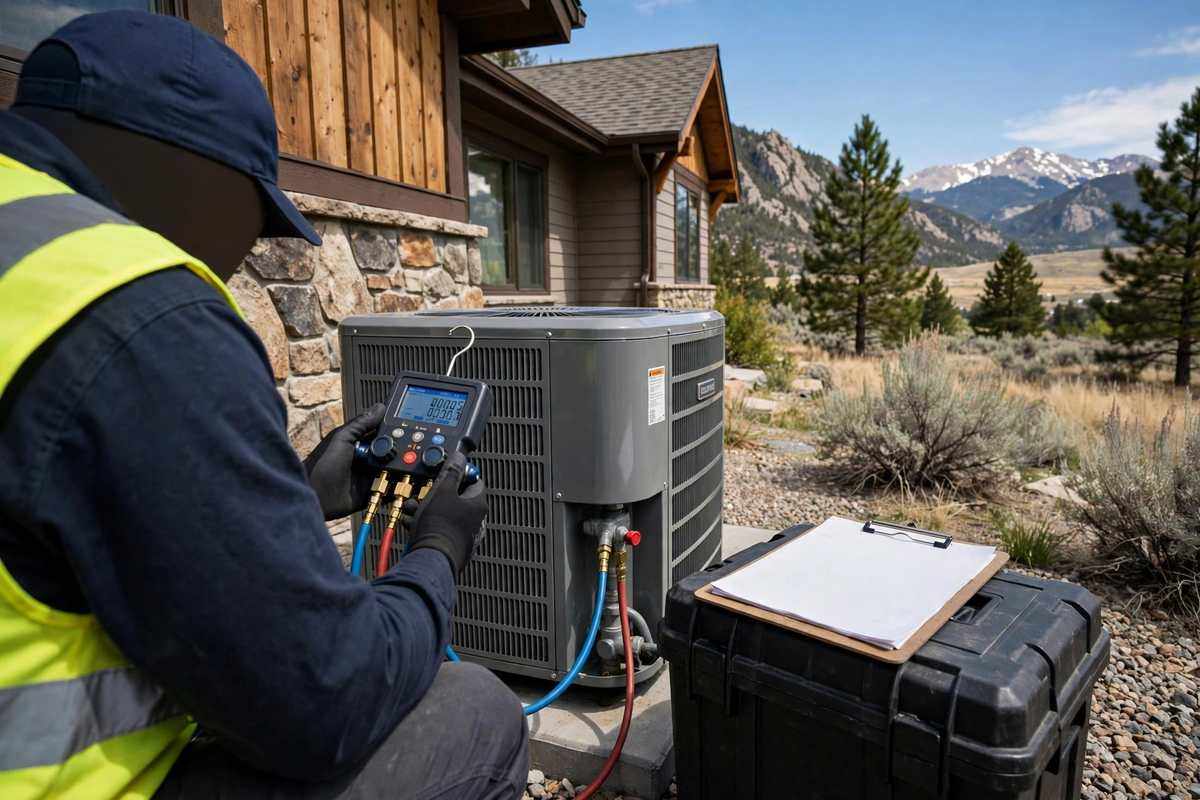
Air conditioning repair in Fort Collins: technician diagnosing a central air conditioner at a home
Diagnose first. Quote in writing. Then repair.
About this service

What AC repair in Fort Collins really involves

AC repair is diagnostic work first and parts second. A technician checks refrigerant pressures, tests capacitors and contactors, inspects both coils, verifies airflow through the ductwork, and confirms the thermostat is calling for cooling correctly. Only after the fault is found does the repair start — and only after you have seen the quote.

Fort Collins gives cooling systems a particular kind of workout. The city averages only about 30 days a year at or above 90°F, but those afternoons arrive fast after cool mornings, and the design cooling temperature is around 93°F (ASHRAE 0.4% value 93.5°F) with a dry 60.5°F wet bulb. Systems here cycle hard on hot afternoons and sit idle through long cool nights, which is tough on capacitors and contactors. Add altitude — at 5,003 feet an air conditioner loses roughly 10–20% of its sea-level rated capacity — and a system sized from a sea-level chart is already working behind the curve. Older homes add their own problems: many pre-1990 houses, nearly half the city's stock, had cooling added years after they were built, with ductwork squeezed into spaces never designed for it. That is why a Fort Collins repair visit has to look at the whole system — charge, airflow, ducts and controls — not just the part that failed.

  • ✓ Full diagnostic before any repair is quoted
  • ✓ Repair-versus-replace explained with real numbers
  • ✓ Refrigerant work that follows EPA Section 608 rules
  • ✓ Open 24 hours — call any time, day or night
What's included

What our AC repair service includes

Every repair visit follows the same sequence: find the fault, show you the options, fix what you approved, and test the system before leaving. Here is what that covers.

01
✓

Full system diagnostic

We measure refrigerant pressures, test electrical components, inspect the evaporator and condenser coils, check airflow and confirm thermostat operation. The diagnostic is what separates a repair that holds from a part swapped on a guess.

02
✓

Written repair quote

Before any work starts you see the parts, the labour and the total, and the repair-versus-replace comparison where it matters. Nationally, AC repair ran $450–$2,000 in October 2026 (Angi, national average $350 for general HVAC repair) — a useful benchmark, not a quote; your price depends on the fault and the system.

03
✓

Capacitor and contactor replacement

The two most common no-cool failures in Fort Collins are electrical. A swollen or open capacitor and a pitted contactor are quick to confirm with a meter and straightforward to replace once diagnosed.

04
✓

Refrigerant leak repair

Low charge is a symptom, not a diagnosis. We locate leaks with electronic detection and pressure testing, repair the line or fitting, evacuate the system to remove moisture, and recharge to the manufacturer's specified weight. Refrigerant handling follows EPA Section 608 rules.

05
✓

Coil and drain service

Dirty evaporator coils and clogged condensate drains cause most frozen indoor coils. We clean coils and clear drains so the system can move air and shed water properly, and we check the float switch that should stop an overflow before it stains a ceiling.

06
✓

Post-repair performance test

After the repair we run the system and re-check pressures, amp draw and supply-air temperature. If the numbers are not right, the job is not finished.

How it works

How our air conditioning repair process works

Call (970) 932-2324 any time. Tell us what the system is doing — why your AC is not cooling the house, blowing warm air, short cycling, leaking water, making noise — and we will ask the questions that point the technician at the right fault.

The technician confirms the complaint and runs the full diagnostic: refrigerant pressures, electrical readings, coil condition, airflow and thermostat operation. This pinpoints the actual failure instead of guessing at it.

You get a written quote listing parts, labour and total, plus an honest repair-versus-replace comparison when the system is old or the repair is major. No work starts until you approve the price.

We complete the approved repair, then run the system and re-check pressures, amp draw and supply-air temperature to confirm the fix holds under load.

We show you what failed, what was replaced, and what to watch for — a filter schedule, a drain to keep clear, a noise that means call back. You keep the written record of the work.

STEP 01Call and describe the symptoms

Call (970) 932-2324 any time. Tell us what the system is doing — not cooling, blowing warm air, short cycling, leaking water, making noise — and we will ask the questions that point the technician at the right fault.

Tools & methods

Tools and methods we use on every job

01
✓

Manifold gauges

Measure high-side and low-side refrigerant pressures to diagnose charge level, restrictions and compressor performance. Every sealed-system diagnostic starts here.

02
✓

Multimeter

Tests capacitors, contactors, transformers and motor windings. Most no-cool calls trace to an electrical failure a meter can confirm in minutes.

03
✓

Thermal imaging camera

Finds temperature differences across coils, ductwork and electrical connections, catching restricted airflow and hot spots the eye cannot see.

04
✓

Refrigerant recovery machine

Recovers refrigerant before any line or component repair, as the EPA Section 608 rules require on every sealed-system job.

05
✓

Vacuum pump

Pulls a deep vacuum after a repair to remove moisture and non-condensables. Skipping this step is why some repairs fail within a season.

06
✓

Duct leakage tester

Measures duct leakage before and after sealing work, so airflow problems are quantified rather than guessed at.

Real results

AC repair, home by home in Fort Collins

Fort Collins homes

Frozen coil in a 1970s Midtown home

Midtown's 1950s–1970s ranches and split-levels often carry cooling that was added long after the furnace, with undersized returns and filters that have not been changed in months. A frozen indoor coil is the classic result: restricted airflow drops the coil below freezing and ice builds until the system stops cooling altogether.

What good work addresses: thawing the coil, then finding the cause — a clogged filter, a failing blower motor or low refrigerant — and fixing that cause before restarting, with airflow and charge verified so the ice does not come straight back.

Call (970) 932-2324 →
Fort Collins homes

Short cycling in a Harmony Corridor two-storey

Large 2000s two-storey homes along the Harmony Corridor commonly cool unevenly: the upstairs bakes while the downstairs is fine, and the system starts and stops every few minutes. Short cycling can mean a thermostat or charge problem, or a system that was oversized for the home's actual load at altitude.

What good work addresses: measuring runtime, temperature split and refrigerant charge, and testing the thermostat and wiring, so the fix matches the cause — a control or charge repair where that is the fault, and an honest sizing conversation where the equipment itself is the problem.

Call (970) 932-2324 →
Fort Collins homes

Water leaking from the air handler in Campus West

Rental homes around Campus West see heavy summer use and long gaps between filter changes. A clogged condensate drain lets the pan overflow, and a bypassed float switch removes the one safety device meant to stop it — the first sign is often a stain on the ceiling below the air handler.

What good work addresses: clearing or replacing the drain line, restoring the float switch, and checking the trap and pitch, so the pan drains properly and the next clog shuts the system down instead of soaking a ceiling.

Call (970) 932-2324 →
Problems we solve

Cooling problems we fix every week in Fort Collins

Most no-cool calls trace to one of a handful of failures. Here are the ones we see most often in Fort Collins and how we approach them.

Ask a pro →
01

AC blowing warm air on a 95-degree afternoon

We check refrigerant charge first, then the compressor and capacitor. Most warm-air calls trace to a low charge from a leak or a failed capacitor. We find the leak, repair it, recharge to specification, and replace the failed electrical part.

↗
02

Frozen AC unit with ice on the indoor coil

We shut the system down, thaw the coil, and find the cause — usually a clogged filter, a failing blower motor or low refrigerant. We fix the root cause, then verify airflow and charge before restarting.

↗
03

Short cycling — AC turns on and off every few minutes

We test the thermostat, check refrigerant charge, and measure runtime and temperature split. If the system is oversized for the home at 5,003 feet, we show you the numbers and discuss a properly sized replacement. If it is a thermostat or charge issue, we repair it.

↗
04

Water leaking from the air handler or a ceiling stain

We clear the drain line, check the pan and float switch, and verify the trap is properly pitched. If the drain is undersized or clogged with growth, we replace it and add a safety switch to prevent future overflows.

↗
Proof you can check

How HVAC licensing works in Fort Collins

  • HVAC work in Fort Collins is licensed by the City of Fort Collins, not the state — Colorado licenses only electricians and plumbers at state level. Fort Collins licenses HVAC contractors through the City — ask us for our licence details when you call.
  • Refrigerant handling follows EPA Section 608 rules as a general industry requirement.
  • 5.0 ★ (23 Google reviews) — all 23 reviews are 5-star.
  • Open 24 hours · 7 days a week — 2757 Sternwheeler Dr, Fort Collins, CO 80524.
Customer reviews

What Fort Collins customers say

★★★★★
“Fantastic business! Dennis is amazing, fixes, replaces, installs and knows everything about his profession. He under cut another competitor by $5800 and never exaggerates work that doesn't need doing. Very trustworthy, and very much appreciated. I have another whole AC unit that will need replacing soon, and I know who I'm going to for the job. Thanks!”
JH

James HadleyGoogle review · 5 months ago

★★★★★
“Denis is very professional and good guy who understands the systems well and fixes them in minutes”
EI

Eshwar IllaGoogle review · 3 months ago

At a glance

ProblemWhat we check or do
AC blowing warm air on a 95-degree afternoonWe check refrigerant charge first, then the compressor and capacitor.
Frozen AC unit with ice on the indoor coilWe shut the system down, thaw the coil, and find the cause — usually a clogged filter, a failing blower motor or low refrigerant.
Short cycling — AC turns on and off every few minutesWe test the thermostat, check refrigerant charge, and measure runtime and temperature split.
Water leaking from the air handler or a ceiling stainWe clear the drain line, check the pan and float switch, and verify the trap is properly pitched.
Good questions

Frequently Asked Questions

(970) 932-2324 →

15–20 years is the usual answer for Fort Collins (Balance Point, November 2026 research). What shortens it here is altitude — roughly 10–20% capacity loss at 5,003 feet versus sea-level ratings — plus hard cycling on hot afternoons, neglected filters and ductwork that was retrofitted into a house never built for cooling. A system that has been maintained and correctly sized lasts toward the top of that range.

Repair usually makes sense when the system is under about 12–15 years old, the fault is a single component such as a capacitor or contactor, and the AC repair cost is a small fraction of a new system. Replacement is worth a serious look when the unit is 15–20 years old, the repair is major (compressor or coil), or repairs keep coming every season. Nationally, AC replacement ran $3,887–$8,073, averaging $5,978, in October 2026 (Angi, national figures) — use that as context, not as a Fort Collins quote.

The three most common causes are a failed capacitor, a dirty evaporator coil and low refrigerant from a leak. A frozen indoor coil usually means restricted airflow from a clogged filter or a failing blower motor. Short cycling often points to an oversized system or a thermostat fault. A diagnostic that checks charge, airflow, electrics and controls finds which one it is.

A repair that swaps a failed component like-for-like does not normally trigger a mechanical permit. A full system replacement does — furnace, AC, heat-pump and mini-split replacements all trigger a mechanical permit in Fort Collins, applied for through the Accela Citizen Portal, with permits valid for 180 days. Permit fees were not verified at the time of writing (November 2026), so no fee figure is published here.

Ready when you are

AC not cooling? Call (970) 932-2324

Tell us what the system is doing and we will diagnose the actual fault, quote the repair in writing, and test the fix before we leave. Open 24 hours, 7 days a week.

Call (970) 932-2324 →
Call to book

Get in Touch

Call (970) 932-2324 any time, day or night. We are open 24 hours, 7 days a week, from 2757 Sternwheeler Dr, Fort Collins, CO 80524. Phone is the way to reach us — there is no email address for the business, so call any time, day or night — we are open 24 hours, 7 days a week.

Call anytime(970) 932-2324
Office hoursOpen 24 hours · 7 days a week
↗
Emergency?Call now